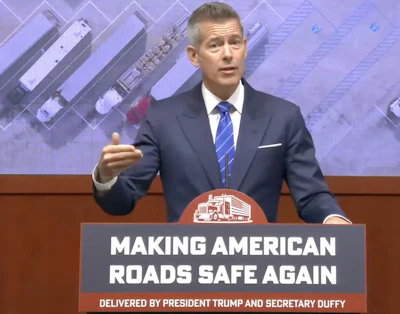

Signed into effect April 28, one of Trump’s earlier executive orders, this one aimed ostensibly at highway safety, proved to be part of the administration’s sweeping and controversial immigration and border enforcement efforts. This order rescinded the 2016 guidance document titled, “English Language Proficiency Testing and Enforcement Policy MC-ECE-2016-006,” and issued a new one to fully enforce the regulation requiring truckers to be able to speak and read highway signs in English. An earlier such order designated English as the nation’s official language.
Trump’s executive order also required a review and tightening of state policies for the issuance of commercial driver’s licenses, especially those issued to non-domiciled drivers.
It also directed Secretary of Transportation Sean Duffy to “identify and begin carrying out additional administrative, regulatory, or enforcement actions to improve the working conditions of America’s truck drivers.” This led to the announcement in June of a series of initiatives, pilot programs, and regulatory updates designed to support America’s truck drivers. These included:
- Expanding truck parking
- Withdrawing the proposed mandate of speed limiters, which was unpopular with truckers
- Not extending the electronic logging device mandate to pre-2000 models
- Eliminating double-brokering
- Creating pilot programs to study flexible sleeper berth combinations, and splitting the 14-hour on-duty time
But the Trump administration singled out several issues for specific attention, and at times, highly public criticism.
Non-Domiciled CDLs in crosshairs
The awarding of CDLs to foreign drivers – including those in the U.S. with legal working permits – became a high-profile target for the Trump administration. An audit of states’ licensing departments found 17 states and the District of Columbia out of federal compliance for how they issue non-domiciled CDL.
Duffy has publicly criticized and threatened several states with the loss of federal highway funds unless they changed how they issue non-domiciled CDLs. He called out eight states and clashed publicly with California, Pennsylvania, Minnesota and New York.


The FMCSA ordered all states to stop issuing non-domiciled CDL:s and revoke those they had already issued. It’s estimated that would remove as many as 200,000 foreign truckers from the nation’s trucking industry. The emergency final rule issued by FMCSA attracted more than 8,000 online comments.
However, a lawsuit filed on behalf of two longtime foreign drivers has halted the revocations for the time being.
This will remain an issue to watch in 2026.
Attacking CDL mills
On Dec. 1, Duffy announced the removal of nearly 3,000 commercial driver’s license training providers from the Federal Motor Carrier Safety Administration’s Training Provider Registry. He said those providers failed to equip trainees with the proper standards of readiness. Another 4,500 training providers were placed on notice due to potential noncompliance.
Duffy used the announcement as another opportunity to continue Trump’s efforts to vilify former President Joe Biden.
“This administration is cracking down on every link in the illegal trucking chain. Under Joe Biden and (Transportation Secretary) Pete Buttigieg, bad actors were able to game the system and let unqualified drivers flood our roadways. Their negligence endangered every family on America’s roadways, and it ends today,” said Duffy. “Under President Trump, we are reigning in illegal and reckless practices that let poorly trained drivers get behind the wheel of semi-trucks and school buses.”
The Training Provider Registry lists all providers authorized to offer federally required Entry-Level Driver Training for CDL students. In the past, CDL training providers were able to self-certify that they met federal training standards.
Duffy said this is the first step in FMCSA’s review of the 16,000 training providers listed on the TPR to identify and remove noncompliant providers.
Duffy said CDL training providers were being removed due to:
- Falsifying or manipulating training data
- Neglecting to meet required curriculum standards, facility conditions, or instructor qualifications
- Failing to maintain accurate, complete documentation or refusing to provide records during federal audits or investigations
Training providers that receive a notice of proposed removal were given 30 days to respond to FMCSA and provide evidence of compliance to avoid removal from the registry. During this period, the provider’s name will be included on the TPR Proposed Removal List, and the provider must notify all current and scheduled driver-trainees of its proposed removal status.
Targeting electronic logging devices
Throughout 2025, the FMCSA actively worked at cleansing its list of electronic logging devices. As the year draws to a close, more than 30 ELDs were stricken from the agency’s list of registered devices.
At the same time Duffy announced CDL trainers were coming under scrutiny, the FMCSA announced it was undertaking “a complete overhaul” of the vetting process for ELDs. The agency said its goal was to ensure non-compliant devices are blocked before they ever reach FMCSA’s Registered ELD list.
“American families deserve to feel safe sharing a road with semi-trucks, and we want truck drivers to have the best tools to maximize those safety precautions,” said FMCSA Administrator Derek Barrs. “By strengthening our review process for ELDs, we are ensuring the industry can rely on trusted equipment and that hardworking drivers are prioritizing their health and well-being, so they are best prepared to keep driving America’s economy forward.”
Under the previous system, ELD producers were allowed to self-certify their devices met FMCSA standards, making it easier to register non-compliant devices or re-register devices that had been revoked, leading to repeated revocations and costly, inconvenient replacements for carriers.
A common complaint was that some devices were created in such a way that allowed some carriers or drivers to manipulate their devices to easily and illegally falsify readings.
The FMCSA said its updated process closes this loophole, “giving carriers and drivers a greater peace-of-mind that the ELDs they purchase are accurate, reliable, and compliant.”
According to a statement from the FMCSA, key features of the new vetting process include:
- Initial Review: Verification of contact information, technical specifications, and device images.
- Fraud Detection: Cross-checking new applications against active, inactive, revoked, and in-process lists.
- Application Categorization:
- Category 1 – Approved: Application has met all necessary requirements for approval.
- Category 2 – Information Requested: Application is pending further information from the applicant.
- Category 3 – Further Review: Application requires additional internal assessment and may require additional documentation from the applicant.
- Category 4 – Denied: Application does not meet the required standards for approval.
ICE focusing on truckers
Immigration and Customs Enforcement (ICE) officers have operated in numerous cities with mostly Democrat administrations for several months. They also have joined forces with several state police agencies and been part of on-highway inspection stops. In doing so, they have detained drivers who may have entered the U.S. without legal documentation.
There have been such stops in Alabama, Oklahoma,Wyoming, and Texas. More are expected.
Tariffs troubled trucking
The president's on-again, off-again approach to tariff's was more tan a little unsettling for the trucking industry. Not only did they rattle the supply chain, but also proved to undermine the prices and purchases of new trucks.
Overwhelming, Trump's erratic announcements of sweeping tariffs prompted many businesses, especially major retailers, to increase orders and stockpile goods early in the year. This reduced the number of shipments throughout the rest iof the year, especially trucking's peak season.
In November, Trump imposed Section 232 tariffs, which added 25% tariffs on imported media- and heavy-duty trucks. Trucks and parts qualifying under the United States-Mexico-Canada Agreement (USMCA) are subject to tariffs only on their non-U.S. content, not the full value.
Still, many carriers delayed purchases of new trucks.