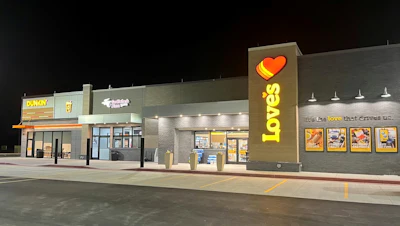
Love's Travel Stops has big plans for 2026.
In a call with media Wednesday, Love's President Shane Wharton outlined a detailed plan focused on growth and increased services for professional drivers and other motorists.
Wharton's plan for the 668-store chain calls for:
- building 20 new locations
- rebuilding and remodeling 35 existing stores
- creating 1,500 new free truck parking spaces, which is about 100 more than the number built in 2025
- adding new processes and items to its Love's Fresh Kitchen food offerings
- adding eight more Buffalo Wild Wings Go outlets
- opening its first Whataburger in the beginning of this year in San Antonio, Texas
- refreshing many of the company roadside service trucks
- increasiong service for RV owners by adding 23 new RV stops, 150 new hookups, and begin selling RV tires and batteries
- upping the number of EV chargers
- opening a biodiesel refinery
"Our 2026 priorities reflect what has always mattered at Love’s, delivering a best-in-class customer experience every time, no matter the part of our business,” said Wharton, “This year, growth means new and updated locations, expanded food and snack options, added amenities for RVers, and continued reinvestment in the business through a stronger loyalty program, and updated technologies, all focused on strengthening Love's brand to drive customer value.”
Wharton also said that Love's will continue to "play offense" in the face of an uncertain economy by sticking to its business plan and building on what works for the company.
In 2026, Love’s plans to invest $700 million in building new locations and remodeling existing ones under its newly named Road Ahead Plan, according to Wharton. Under this initiative, more than half of Love’s locations will be newly constructed or remodeled by 2035.
New this year, Love’s will close locations that are being remodeled to complete construction faster while still offering amenities like fuel, restrooms and light food and drinks to customers via a mobile building.
With existing and new locations, Love’s continues its support of professional truck drivers by providing amenities and services that support them. Plans call for two new truck care locations and four truck washes to open in 2026.
Wharton said Love’s will launch a next-level loyalty experience with an enhanced Love’s Rewards program. Slated to be introduced later in February, the Love's Rewards program will now allow casual customers -- non-professional drivers -- to start earning points per dollar spent inside the store and on gas and auto-diesel.
Additionally, all customers will now be able to earn even more points than before, including extra points per dollar for Love’s branded products and Love’s Fresh Kitchen items. This program will provide much needed value for the traveling public and enable Love’s to provide relevant offers to all drivers throughout their journey, according to Wharton.




Last year, Love's expanded how customers get their food by introducing order-ahead capabilities at Arby’s, Hardee’s, Taco John’s, Bojangles and Carl’s Jr., along with intelligent kiosks to Arby’s, enhancing customer experience and making it faster and easier to get food on the go. This year, Love’s will expand the use of intelligent kiosks at additional restaurants.
Whartoin said Love's will continue adding alternative fuels. He said he company will continue growing its network of electric vehicle (EV) chargers and hydrogen and CNG stations through Love’s Alternative Energy (LAE). Love’s will continue expanding its EV charging network through the National Electric Vehicle Infrastructure (NEVI) grants program with the installation of 100 new EV stalls in 2026. The company plans to deploy fast chargers at approximately 150 locations over the next several years, reinforcing its dedication to supporting the growing EV market.
Construction of Heartwell Renewables, a new state-of-the-art renewable diesel refinery in Hastings, Nebraska, is expected to be completed later this year, according to Wharton. The refinery will employ approximately 70 people and initially produce 80 million gallons of renewable diesel annually.