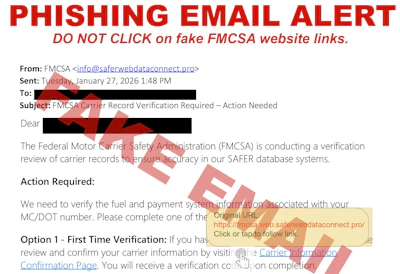
Be especially cautious when receiving any email proporting to be from the Federal Motor Carrier Safety Administration: it could be a dangerous fake.
The FMCSA recently announced it has identified a new, aggressive phishing campaign in which motor carriers receive emails falsely claiming to be from Department of Transportation or FMCSA officials. These emails often contain professional-looking documents and legitimate-looking links, but they are fake and designed to steal sensitive information or demand illegal payments, the FMCSA warned.
The agency said:
- These emails do not come from USDOT or FMCSA
- Official FMCSA correspondence almost always uses an email address ending in .gov. In special circumstances, such as customer satisfaction surveys after contacting the FMCSA Contact Center, emails may come from a non-.gov address. These surveys request feedback only and will not ask for personal, payment, or account information.
- Links in phishing emails typically lead to suspicious, non-.gov domains (for example, fmcsa.web.saferwebdattaconnect.pro).
- FMCSA will never request payment or sensitive information (like UCR, PIN, SSN, EIN, or bank details) through unsolicited messages.
- If you have any doubts, avoid clicking links and verify all communications directly through official FMCSA channels, including contacting the FMCSA Call Center at https://ask.fmcsa.dot.gov/app/ticket or call 1-800-832-5660.
FMCSA said it will never request Social Security numbers, bank account details, or credit card information via unsolicited emails or phone calls. If sensitive information is required, you should initiate contact through official FMCSA phone numbers or web portals.
FMCSA suggests what to do if you receive a suspicious email including:
- Do not click on links or open attachments.
- Do not reply to the sender.
- File a complaint with the FBI through their IC3 site at https://www.ic3.gov/ .
- Report suspicious emails to the FMCSA Contact Center at https://ask.fmcsa.dot.gov/app/ticket or call 1-800-832-5660.
- Visit the Federal Trade Commission site at https://consumer.ftc.gov/ for more on phishing and email verification.