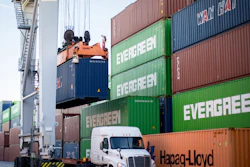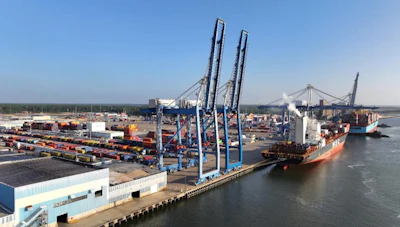
SC Ports plans to expand roll on-roll off (ro-ro) operations to its rail-served North Charleston Terminal to further support the state’s automotive industry. SC Ports’ Board of Directors voted recently to approve the design contract, the first step in the process.
The vote will further expand SC Ports’ ro-ro capacity and capabilities to support existing customers and partners’ supply chains, while also allowing additional shippers to move more cargo through the Port of Charleston.
The project also aligns with SC Ports’ commitment to build infrastructure that will generate immediate revenue, enabling the port to move cargo onsite years ahead of the long-term effort to expand container capacity at North Charleston Terminal.
Demolition of the adjacent former paper mill site — which the port acquired with state support in 2024 — will begin this summer. Work to prepare the terminal for ro-ro operations will begin in 2027, with an anticipated 2028 completio, according to SC Ports.
Breakbulk and ro-ro operations are currently handled at Columbus Street Terminal, which has capacity to move more than 250,000 vehicles annually through the Port of Charleston. This plan creates more capacity at Columbus Street Terminal for additional waterborne commerce.
The planned expansion includes rail upgrades and building ro-ro capabilities. Rail operations will be served by SC Ports’ rail partner Palmetto Railways.
Class 8 sales up; driven by rates, driver supply
New equipment demand continues to be buoyed by materially improved spot and contract rates, driven largely by the rapid shift in driver supply, as published in the latest release of ACT Research's North American Commercial Vehicle OUTLOOK.
“Class 8 order strength continued in May, with preliminary orders of 26,500 units, up 103% y/y and 12% m/m (SA), respectively. Despite entering what is historically a weak period in the annual order cycle, new equipment demand remains supported by materially improved spot and contract rates, on top of regulatory clarity,” according to Ken Vieth, ACT’s President and Senior Analyst. “Spot freight rates have absorbed elevated fuel costs in stride, with net fuel rates rising ~39% y/y at the beginning of June. Spot rates are currently above contract rates, a positive omen for carriers’ contract rate negotiations and future profitability.




"Driver supply, according to ACT’s monthly survey of mid- to large-sized for-hire carriers, flipped from comfortable to tight beginning in January. The situation has deteriorated every month since, with April’s reading signaling tightness in the driver supply at levels not seen since mid-2021.”
Vieth added, “FMCSA’s crackdown on non-domiciled CDL holders became official in March, but self-selection appears to have started around the start of 2026. Add crackdowns on cheater ELDs, closed driver schools, and strict immigration enforcement that are squeezing productivity via restricting logbook cheating and a narrowing of the pipeline of new CDL candidates needed to offset freight growth and baby boomer retirements.
"Taken together, a strong case can be made that the driver supply will remain tight for an extended period, which in turn will allow fleets to find pricing relief on the heels of three years of falling profitability. Carriers’ profitability reprieve coupled with inbound regulations associated with even higher equipment costs in 2027 have also helped spur Class 8 order activity. Without a regulation looming, the trailer market is still waiting for materially stronger demand to arrive.”
ICYM I
TCA proposes reform and expansion of FMCSA to focus on safety issues
8 busted in connection with multimillion dollar cargo theft ring