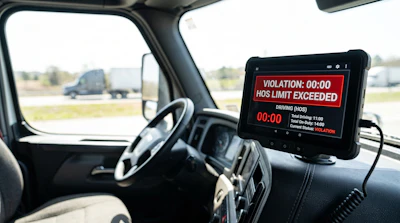
As the federal government continues its efforts to attack fraud in the trucking industry, part of its focus has been on the growing problem of the manipulation of data provided by the electronic logging devices required of every driver. The most recent effort was to removed 133 ELDs from the list of available devices.
Now, a leading trucking advocacy group has issued a series of recommendations aimed at eliminating ELD fraud, including ending the ability of ELD makers to self-certify their devices meet federal standards.
The American Trucking Associations today released a new report outlining six recommendations to strengthen the integrity of ELDs and combat emerging forms of ELD fraud that it said threaten highway safety.
The report, “The Road to ELD Certification: Recommendations of ATA’s Working Group on ELD Fraud,” proposes short- and long-term measures the association said would build on the Federal Motor Carrier Safety Administration's work by strengthening fraud detection and enforcement while establishing a durable, resilient certification system.
The report makes six recommendations. They include:
1.) Implement checks on electronic records of duty status for common indicators of fraud. FMCSA should use automated checks to identify warning signs such as out-of-sequence file numbers, impossible distances, and driver information manipulation, followed by human review of flagged records.
2.) Require companies registering ELDs to have a verified U.S. footprint. Establishing a U.S.-based presence would enhance the ability of FMCSA and law enforcement to hold providers accountable when noncompliance or fraud is identified.
3.) Enhance FMCSA’s process for investigating potential fraud. Building on the agency’s aggressive actions, ATA recommends formal processes for receiving, tracking, and resolving fraud reports, particularly those from law enforcement, along with additional resources necessary to investigate potential violations effectively. ATA also calls on Congress to provide FMCSA with sufficient staff and financial resources to carry out this work.
4.) Build an independent certification program. FMCSA should retain authority over technical standards, regulatory interpretation, investigations, and enforcement while relying on qualified independent organizations to perform the specialized technical work associated with certification. The framework should focus primarily on ELD software, where the greatest opportunities for manipulation exist, and draw lessons from Canada’s third-party certification model while remaining tailored to the U.S. regulatory system.
5.) Ensure certification means sustained compliance. Certified devices should undergo regular reviews throughout their lifecycle, certification providers should be subject to periodic audits, and ELD providers should periodically reaffirm registration information. This would give FMCSA continuing visibility as devices and technology evolve rather than treating certification as a one-time event.
6.) Regularly review and update ELD technical requirements. FMCSA should ensure its technical standards evolve alongside technology and emerging methods of circumvention, reduce ambiguity that can undermine consistent enforcement, and support future fraud detection and certification efforts.


The recommendations were developed by ATA’s working group on ELD fraud, which was established after ATA’s Safety Policy Committee voted in October 2025 to support stronger measures to ensure ELD integrity, including third-party certification.
“FMCSA deserves recognition for its proactive efforts to strengthen vetting procedures, enhance oversight, and identify and remove bad actors from the industry, while remaining responsive to concerns raised by legitimate industry stakeholders,” said ATA Chief Advocacy & Public Affairs Officer Henry Hanscom. “Those efforts have created important momentum. ATA’s recommendations provide a roadmap to continue that progress by making fraud harder to commit and easier to detect and shut down. A strong, sustainable certification system will protect responsible carriers, support law enforcement, and, most importantly, make our highways safer.”