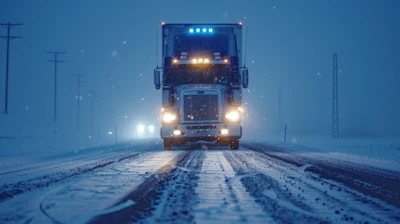
Truckers running through the northern half of the U.S. may catch a break this winter, as forecasters are calling for less snow and milder temperatures for much of the region.
However, if your deliveries take you through the South, be aware there could be more storms and possible flooding to contend with.
All of this is due to warmer surface temperatures in the Pacific Ocean, and several forecasting outlets have somewhat differing takes on what lies ahead.
NOAA’s U.S. Winter Outlook, shows how El Nino will likely influence the upcoming winter months (December 2026 to February 2027), with:
warmer-than-average temperatures expected across the northern U.S.
wetter-than-average conditions likely across the southern U.S., from California to Florida, and along the Eastern Seaboard
drought improving for the majority of the country, including areas in the East, Southern Great Plains and Southwest.
Accuweather is forecasting the current El Nino -- a climate pattern marked by unusually warm ocean surface temperatures in the central and eastern tropical Pacific Ocean -- could be the strongest in history.
It's expected to cause snowfall to run below to well below average across much of the Northwest, Midwest, Great Lakes, Ohio Valley, and Northeast, according to Accuweather forecasters. And, above-average temperatures and fewer Arctic outbreaks are forecast across much of the northern United States.
“As we know from decades of observations, a very strong El Nino will likely bring a southward and eastward shift to the jet stream for the contiguous U.S., which tilts the odds toward stormier weather across the South,” said Ken Graham, director of NOAA’s National Weather Service. “While higher chances of rain and snow may bring relief to drought-afflicted areas, too much precipitation on dry soil can fuel destructive flash floods and mudslides. Now is the time for communities and individuals to plan ahead for the upcoming winter.”
Temperature Outlook
- Warmer-than-average temperatures are favored for northern California, the Pacific Northwest, Midwest, Mississippi Valley, much of the East, Alaska and for Puerto Rico / U.S. Virgin Islands.
- Near-normal temperatures are most likely for parts of the Southeast including Florida.
- Hawaii and much of the Southwest have equal chances of below-average, near-average or above-average seasonal mean temperatures.
Precipitation Outlook
- Wetter-than-average conditions are most likely across the southern tier, from the Southwest to the Southeast, and along the East Coast.
- Elevated odds for drier-than-average conditions for Hawaii, much of Alaska, the northern Mountain West, some areas in the Great Lakes and the western Pacific Islands.
- Areas in the Intermountain West, northern Plains, Ohio Valley and Puerto Rico / U.S. Virgin Islands have equal chances of below-average, near-average or above-average seasonal total precipitation amounts.
NOAA has also implemented upgrades to many of its winter weather products for the 2026-27 winter season.
The National Weather Service said its Probabilistic Precipitation Portal is now operational. This platform enables users to view the low-end, expected, and high-end amounts of snow, ice and rain, as well as the probabilities of precipitation exceeding specific thresholds. Data are accessible through an interactive map, tables and graphics to assist local partners and emergency managers with decision support.


The National Weather Service said it will also implement the use of “Particularly Dangerous Situation” wording in select Blizzard Warnings and Ice Storm Warnings this season. This language will help forecasters alert the public about high-confidence blizzards or ice storms of historic severity.
Two slightly more traditional forecasters have outlooks of their own.
The Old Farmer's Almanac has its own take on the upcoming season. It is forecasting:
- Temperatures: Mostly mild, with a colder stretch from central New England through the Appalachians and Ohio Valley, plus Hawaii.
- Wet/Dry: Wetter than normal across much of the West and in parts of the South, Midwest, and Florida; drier than normal in parts of the East, Plains, and Southwest.
- Snowfall: Snowier in parts of the Northeast and Appalachians, parts of the West, and Alaska.
The Farmer's Almanac's take on the winter is:
"Winter 2026–2027 may be defined by contrasts: an active and wet southern storm track, quick bursts of snow and cold across the North, and a particularly unpredictable mix of precipitation in the Northeast."