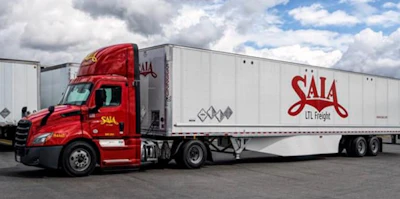
The Federal Motor Carrier Safety Administration is seeking comments on a major carrier's request to allow learner permit holders to haul doubles on the road as part of the company's training program,.
FMCSA recently announced Saia LTL Freight has requested a five-year exemption from the requirements in 49 CFR 383.93(b)(1) and 49 CFR 383.37(a).
Saia requests relief from these requirements to permit CLP holders in its training program to receive behind-the-wheel coaching while driving with double trailers. The trainee would be under the direct supervision of an experienced CDL holder who possesses a valid double/triples endorsement, according to Saia's request.
According to the FMCSA, Saia said the exemption would apply to about 300 trainees annually using a fleet of some 19 training vehicles, with a gross vehicle weight of 80,000 lbs. or less. According to Saia's application, the exemption would streamline the training pipeline and allow its trainees to gain on-the-road experience with doubles under expert supervision before taking the final CDL test. Saia said this would increase the supply of qualified drivers for its operations.
In its request, Saia said it would maintain a level of safety equivalent to or greater than the level of safety that would be maintained by compliance with the current regulations by implementing several safeguards. Saia said those safeguards include:
- All trainees must pass a company-administered knowledge test that mirrors the state CDL doubles/triples exam
- Trainees must demonstrate proficiency in coupling, uncoupling, and maneuvering doubles in a closed-yard environment before entering public roads
- All on-road training will be conducted under the direct supervision of a certified trainer/instructor who holds a valid Class A CDL with a T endorsement
- Training will be restricted to vehicles with a gross vehicle weight of 80,000 lbs or less
- Drivers will carry proof of their completed internal training and the company-administered exam at all times while operating
The public has until Dec. 18 to comment. Comments may be made online here.