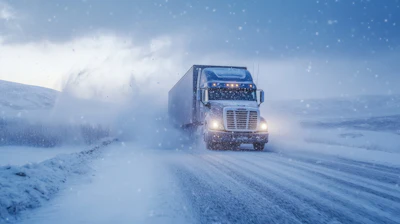
Unless you do your driving strictly in the deep South this time of year, you should expect to drive through some demanding winter weather for the next several months.
The federal Occupational Safety and Health Administration has these suggestions for handling your rig when the going gets wintery.
1. Slow Down: The key to driving safely in snow and ice is reducing your speed. Slowing down gives you more time to react to unexpected situations, such as a sudden stop or an icy patch on the road. Even if the road looks clear, ice can be invisible, so it’s essential to drive at a speed that allows you to maintain control of your vehicle.
2. Accelerate and Decelerate Gradually: Sudden movements can cause your vehicle to lose traction, leading to skids or spins. When accelerating, do so gradually to prevent your tires from spinning out. Likewise, when you need to slow down or stop, apply the brakes gently and in a controlled manner to avoid locking the wheels, which can lead to a loss of control.
3. Use Low Gears: In slippery conditions, using lower gears can help you maintain better control of your vehicle. Lower gears provide more traction and help prevent your wheels from spinning, especially when driving uphill or on winding roads.
4. Avoid Stopping on Hills:Stopping on an incline in snowy or icy conditions can make it difficult to start moving again without slipping backward. If possible, avoid stopping while going uphill. Try to get enough momentum before you reach the hill to carry you over the top without needing to stop. If you must stop, leave plenty of room in front of you and start moving slowly and gradually.
5. Know How to Handle Skids: Even with the best precautions, you may find yourself in a skid. If your vehicle starts to skid, stay calm and avoid slamming on the brakes. Instead, take your foot off the accelerator and steer gently in the direction you want to go. If your rear wheels are skidding, steer in the same direction the rear of the car is sliding. For front-wheel skids, remove your foot from the accelerator and allow the vehicle to slow down until you regain control.



6. Don’t Use Cruise Control: While cruise control is convenient on dry roads, it’s dangerous on icy or snowy surfaces. Cruise control can cause your vehicle to accelerate when it hits a slippery spot, which can lead to a loss of control. Always drive manually in winter conditions to maintain better control over your vehicle.
7. Be Cautious at Intersections: Intersections are particularly hazardous in winter because they often become icy from vehicles frequently stopping and starting. Approach intersections with caution, reduce your speed well before reaching the stop line, and brake gently to avoid sliding into the intersection.
8. Stay Aware of Your Surroundings: Keep an eye on the road conditions and be mindful of other drivers. In winter weather, you may need to adjust your driving style based on what’s happening around you. Look out for brake lights ahead, changes in the road surface, and vehicles that may be struggling with traction.
9. Maintaining Vehicle Control in Slippery Conditions: Keeping a firm grip on the steering wheel and making smooth, deliberate movements is key to maintaining control on slippery roads. You should avoid abrupt actions, such as hard braking or sudden acceleration, as these can lead to loss of control. Instead, you should gently ease off the accelerator and steer smoothly to regain traction.
10. Increasing Following Distance and Braking Time: Winter conditions significantly increase stopping distances. Maintaining a greater following distance from the vehicle ahead is crucial—ideally, about six to eight seconds in snowy or icy conditions. This extended distance provides more time to react and brake safely if the vehicle in front suddenly stops.
And, here are a few bonus tips:
- Use low beams for better visibility and to activate taillights; keep lights clean
- Clear ice from all lights, wipers, and windshields; use fog lights if available
- Use appropriate cold-weather diesel, check DEF, top off other fluids and be sure to have ant-gelling additives with you
- Carry food, water, blankets, warm clothes, first aid, flashlight, flares/triangles phone charger, shovel, and basic tools
- Continuously check conditions for your route and destination using resources like 511 and National Weather Service alerts on your CB
- Understand hours of service rules; drivers can get up to a two-hour extension for adverse driving conditions
- Drivers can legally refuse to drive in dangerous conditions without penalty
- Be sure you know how to put chains on your drive tires, and know which states require chain use in foul weather

![Shutterstock 137842070[88] (1)](https://img.truckersnews.com/files/base/randallreilly/all/image/2021/12/shutterstock_137842070_88___1_.61afbd06e50db.png?auto=format%2Ccompress&fit=crop&h=167&q=70&w=250)