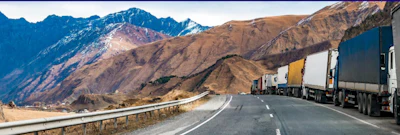
All truckers know there is a huge difference in running a route on a rural, flat highway or through a busy city, or trekking through the mountains. Each setting requires a different set of skills, and the only way to get better is through experience.
However, the latter terrain can be daunting, even for veteran drivers, because in the mountains, conditions can change quickly and small mistakes can have serious consequences.
These drivers, including some of RoadPro's Pro Driver Council members, have plenty of experience with driving in the mountains and recommend these tips.
1. PLAN AHEAD
•“Always have food and warm gear with you to last three to four days. Look and plan ahead for a safe area of refuge and repairs.” – Jim Doyle
• “Extra water & food. Especially in winter [conditions], top off fuel [and] carry fuel additives.” – Gary Johnson
• “When you climb in that truck, stop and think what you are going to do.” – Al Kohl Kohl plays the “what if” game to think through possible scenarios and be prepared.
2. DO A BRAKE CHECK
• “Do a brake check in the morning and then again at the top of the hill.” – Gary Johnson
• “Always stop at every major hill and check if the brakes are heating up.” – Al Kohl Kohl recommends putting your hands over them. “If there’s a cherry glow, don’t go.
3. LET THE TRUCK DO THE WORK FOR YOU
• “If running a truck with an automatic 6-speed transmission, find a pace that is comfortable and safe for the conditions. Keep an eye on your engine temps (even in cold weather) because climbing the mountains can quickly raise the engine temps. For descending mountains, shift into a lower gear (usually for me that is 4th gear in the truck I drive) and then allow the engine brake and the transmission to work together to hold the truck at the desired speed when going down the mountain.” – Kellie Doyle
4. BE PREPARED FOR NO CONNECTION
• “Cell signal in the mountains can be very hit and miss - there is no rhyme or reason to when you have signal or don’t. The key is to know your routes ahead of time and always have emergency supplies with you in case of road closure or break down.” – Kellie Doyle


• “When driving in remote locations or unpredictable weather conditions in high elevations it’s always best to get an ETA to someone in case you do breakdown somewhere you don’t have service.” – Jim Doyle
5. THE WEATHER WILL CHANGE – BE READY
• “Many times, it can be totally clear and sunny at the bottom and nasty/ snowing/windy at the top. Always check radar and wind conditions along the route, because sometimes it is safer to alter the route to go around storms.b Many times, mountain passes can get shut down completely for snow/ice [or] even for wind.” – Kellie Doyle
6. OTHER ADVICE
• “The gear [that you go] uphill in is what you want to go down in, and always go 10 miles slower than the curve recommends downhill.” – Gary Johnson
• “Remember that it’s not a race up and down the mountain, take your time choosing the right gear, and staying in your lane is best.” – Jim Doyle
• “Mountains are not to be feared, but respected.” – Al Kohl
Kohl said he was given this advice from an old timer, which he always remembers: “You can go up and down 100 times but only come down wrong once.”
A bit of preparation will put you at a great advantage. Pair that with a healthy respect of the terrain and all the advice you can take in from veteran drivers, and you’ll be ready to tackle your next route through the mountain