The number of cargo thefts was. down markedly between July and September compared to the same period in 2025. However, the value of stolen cargo increased by $25 million during the period.
Those are the latest findings of a company that monitors the ever-growing problem of cargo theft in the U.S. and Canada.
Verisk, a strategic data analytics and technology partner to the global insurance industry, Wednesday released its third-quarter cargo theft analysis, showing a sharp decline in reported supply chain crime but a growing financial toll from theft.
The company also announced details of:
- how cargo thefts are being conducted
- where they are occurring
- what kind of cargo thieves are targeting
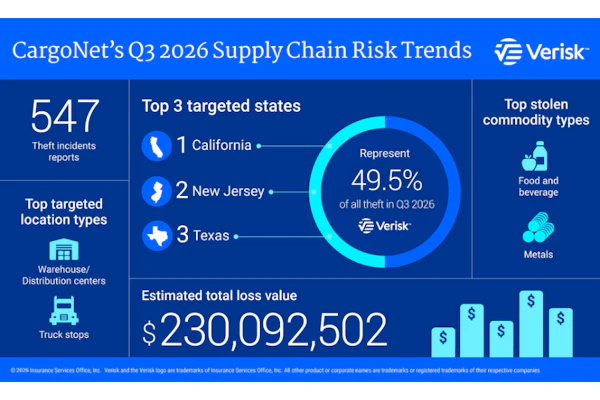
Verisk CargoNet recorded 547 supply chain crime incidents across the United States and Canada from July through September, a 33% decline from the same period in 2025 and a 19% decline from the second quarter.
However, estimated losses for the quarter totaled $230.1 million, up 12% from $205.1 million in the third quarter of 2025, Verisk said. Despite the decrease in reported activity, fictitious pickups, which are generally described as incidents in which deception is used to obtain a shipment, remained close to last year’s level.
Fictitious pickups accounted for 138 incidents in Q3, compared with 147 in 2025, raising their share of reported activity from 18 percent to about 25%, according to Verisk.
The year-to-date figures also show continued financial exposure: estimated losses reached $718.9 million through September, up 39%, while reported incidents fell 25%, from 2,755 to 2,072. The average value of stolen commodities across incidents with a documented value increased by approximately 72%, from $261,115 to $448,456, over the same period.
"We saw mixed results in the third quarter with a decline in reported incidents and fictitious pickups remaining close to last year’s level, but the estimated financial impact grew significantly,” said Keith Lewis, vice president of operations at Verisk CargoNet. "Understanding cargo theft requires looking beyond incident counts and focusing on broader trends, like what is being stolen and where theft is concentrated."
Here's what cargo crooks are stealing:
- Food and beverage remained the leading commodity category with 94 incidents, though down from 178 in Q3 of 2025. Within the category, nonalcoholic beverages accounted for 22 incidents, meat products for 21 and alcoholic beverages for 12.
- Household goods declined from 95 to 49 incidents, and electronics fell from 69 to 46, with computers and accessories remaining a prominent target, accounting for 20 incidents compared with 24 a year earlier.
- Metals were the second most frequently reported commodity category, with 63 incidents, down only slightly from 68 a year earlier. Copper accounted for 34 of those incidents.
- Personal care and beauty incidents declined overall, from 44 to 39, but reported cosmetics thefts increased from nine to 14.
The results illustrate how theft patterns involving individual products can remain persistent, or increase, even when broader commodity and overall incident totals decline. Additionally, ahead of the holidays, these categories are particularly notable theft targets.
Geographically, California accounted for about one-third of all reported incidents, with 182 events, down from 261. New Jersey declined from 66 to 46, Illinois from 52 to 40, and Texas from 105 to 43.
Together, those four states accounted for 57 percent of the quarterly total. County-level reporting highlighted concentrations in Los Angeles, San Bernardino and Riverside counties in California, as well as Harris County, Texas, and Cook County, Illinois.
Earlier in 2026, Verisk CargoNet documented increasingly complex fraud schemes involving compromised business email accounts, internet-based phone systems and transportation industry applications. These methods can allow criminals to impersonate legitimate companies, obtain shipment information or redirect freight already moving through the supply chain. The persistence of fictitious pickups underscores the continued threat these schemes pose, even as overall reported incidents decline, according to Verisk.
Lewis said, “We’re seeing criminals combine digital deception with traditional theft tactics to identify, intercept and redirect high-value shipments. Data center materials are among the valuable commodities attracting attention. As the value of the cargo being targeted increases, strong identity verification, shipment visibility and communication across the supply chain become even more important.”
Looking ahead to Q4, seasonal patterns warrant attention. Verisk CargoNet said it has historically observed increased theft activity during the fourth quarter and into the new year. Activity could escalate as criminals seek to exploit extended facility closures and reduced staffing during the upcoming holiday season.