In one of his company’s The State of Freight webinars earlier this year, FTR’s CEO Jonathan Starks said, “We’ve had an interesting year.”

The year about to draw to a close in a few days has been marked by numerous issues and events that have not just affected but also fundamentally changed the industry from how it was this time a year ago. We’ll take closer looks at several of these major stories.
THE top story of 2025 was one, which normally would not have come close to being singled out for this position among the year’s most important stories.
On Aug. 12 Harjinder Singh attempted to make an illegal U-turn through an “Official Use Only” access point on the Florida Turnpike in St. Lucie County, Florida. A minivan carrying three people slammed into Singh’s trailer, killing all three occupants.
That collision set off a chain of events that rippled through not just the trucking industry, but also through major media outlets, and U.S. politics. That accident, and at least two other similar ones, caused a firestorm of protests against foreign drivers holding U.S. commercial driver’s licenses and the states that issued those CDLs. It also added fuel to the fire of drivers – many of them said to be in the country illegally but given work permits and CDLs – not being able to speak English. And, of course, it led to several lawsuits.
As the year closes, Singh faces charges of vehicular manslaughter and vehicular homicide. And, the trucking industry and law enforcement – including DHS and Customs and Border Protection agents – continue wrestling with the consequences and probably will be at this time in 2026.
The other top stories of 2025, in no particular order, include:
Great Freight Recession continues: A number of factors conspired to continue the downturn of the trucking economy, which began in the middle of 2022. Low demand coupled with excess capacity left over from covid days kept rates and carrier profitability low. Operational costs, especially insurance rates, also kept pressure on fleets. Then came President Donald Trump’s tariffs, and the downturn of industrial output and housing construction. The depressed rates and lack of freight also forced numerous closings and bankruptcies. The outlook for 2026? More of the same for at least the first half of the year.




Cargo theft increases: Simply put, cargo theft in the U.S. and Canada is at epidemic proportions and showed little sign of abating in 2025. It’s estimated to be a $35 billion problem driven by organized crime with steadily increasing sophistication. Targets this past year included high-value electronics, food and beverage, copper and household goods. While cargo thieves have become more and more skilled at intricate identity theft scams, 2025 also saw thieves breaking into the trailers of rigs stopped at traffic lights. A study by the American Transportation Research Institute offered some suggestions on how to combat cargo theft, which in 2025 reached $18 million a day.
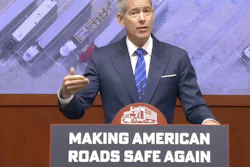
New federal leadership: The new Trump administration brought with it a new cabinet, including Secretary of Transportation Sean Duffy, a former Wisconsin congressman and Fox Business presenter. Early on Duffy’s attention was consumed by a shortage of air traffic controllers caused by recruitment, training and retirement issues. He received some criticism late in the year when he suggested people stop wearing pajamas and dress up when on commercial airline flights. He has been relentless in his pursuit of Trump’s trucking-related goals, and especially vocal in his attacks on California Gov. Gavin Newsom over non-domiciled CDL issues. Former Florida Highway Patrol Chief Derek Barrs was confirmed in October to lead the Federal Motor Carrier Safety Administration.
Trump and trucking: On April 28, President Donald Trump signed an executive order titled Enforcing Commonsense Rules of the Road for America’s Truck Drivers, which would prove to be the opening salvo in a major assault on a long list of issues affecting the trucking industry and thousands of truckers. Many of Trump's orders dovetailed with the administration’s focus on immigration law enforcement and were aimed at political adversaries.
English language proficiency: Trump’s executive order effectively made it mandatory for anyone behind the wheel of a commercial vehicle must be able to speak and read English. (Trump’s earlier executive order made English the official language of the U.S.) Failure to do so would swiftly become an out of service violation. Law enforcement officials in several states took this to heart and by earlier this month, almost 10,000 truckers were placed out of service for failing to meet English language standards during inspections and other traffic stops.
Non-domiciled CDLs: Adjacent to the English language proficiency crackdown came Trump’s push for the elimination of most non-domiciled commercial driver’s licenses, which allow non-U.S. citizens to drive here. Trump, through Duffy, launched a nationwide audit of all states’ programs for issuing non-domiciled CDLs. Several states (California, New York, Colorado, Washington, Minnesota and Texas) were found to have problems and were threatened with the loss of millions of dollars of highway funds. Removal of all non-domiciled truckers could mean removing between 164,000 and 200,000 drivers from the highway. This is being challenged by a lawsuit brought on behalf of several foreign drivers living in this country.
Attacking CDL “mills”: The past year has seen a number of scandals revolving around the issuance of CDLs. It also has seen growing concern by trucking organizations over improperly or insufficiently trained drivers. This has led to a purge of at least 3,000 CDL training providers from the FMCSA’s list. It has also led to the tightening of requirements to be on that list, which up until recently was open to anyone who self-certified they met federal requirements to train new drivers.
Revising the FMCSA’s ELD registry: Just as the CDL trainers could attest to their own qualifications to be on the FMCSA’s list of training providers, so could the makers of electronic logging devices attest to their devices living up to federal regulatory demands. However, throughout the year the agency removed numerous ELDs for being non-compliant. There were accusations that some ELD makers left backdoor access available for carriers or drivers to doctor the readings to gain more driving time. As the year wound down, the agency said it was auditing the list and creating stricter requirements for approving devices.
Autonomous trucks hit the road: In 2025, fully autonomous Aurora Innovation’s tractor-trailers began delivering freight on a regular basis along Interstate 45 between Houston and Dallas. Next year Aurora will join Kodiak in delivering frac sand in Texas’s Permian Basin oil fields. However, Volvo Trucks discontinued its autonomous efforts and focused on electronic powertrains.
Truck parking progressed: The year saw some forward motion on the perpetual problem of truck parking, which once again was near the top driver’s concerns ATRI’s list of critical issues. The commonwealth of Pennsylvania announced it was creating or designation 1,200 new parking spaces, including many along on- and off-ramps that in the past were considered illegal. Ohio announced it was adding over 250 spaces at reconstructed rest areas, and 144 spaces at decommissioned weigh stations. Florida was in the midst of adding some 900 truck parking spaces primarily along the Interstate 4 corridor. Several states added the technology to alert truckers electronically to open parking spaces at rest areas. The FMCSA also announced it was undertaking a study to determine the “monetary benefit” of truck parking. And, the major truck stop and travel center chains continued to be the primary developers of truck parking. Love’s ended 2025 creating 1,408 truck parking spaces.
RELATED NEWS FROM 2025:
Trucker poll: 40% say 2025 was only fair or poor; not optimistic for 2026
Many moves by Trump administration shake up trucking in 2025
In 2025, numerous truckers honored for their skills and achievements
Trucking in 2025 included numerous mergers, acquisitions, closings