The time before and after Thursday's holiday is no time for carriers and drivers to let down their guard, according to a new analysis by cargo theft experts.
Verisk, a strategic data analytics and technology partner to the global insurance industry, Tuesday released its Thanksgiving cargo theft analysis and warning from its CargoNet business.
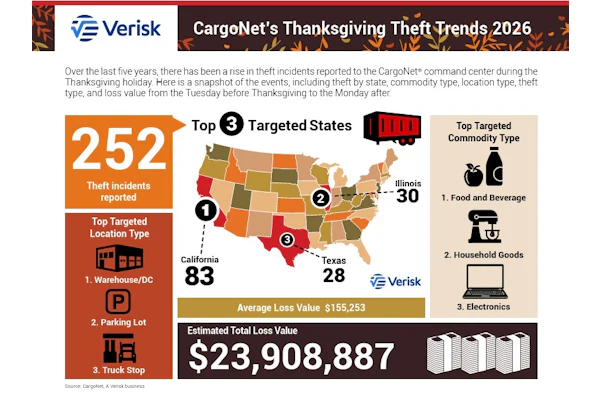
CargoNet recorded 252 cargo theft incidents in the U.S. during the Thanksgiving holiday periods from 2021 through 2025, with an estimated commodity value of about $23.9 million.
For 2026, Verisk CargoNet is highlighting a growing scheme in which cybercriminals posing as drivers and dispatchers respond to carriers' job postings on social media, gain access to company email and phone systems, and use those systems to bid on and steal shipments in the carrier's name. Thieves also continue to favor full truckloads of metals and data center computing hardware.
Verisk CargoNet recommends that shippers, brokers and carriers tighten security and verification from now, through Monday.
Verisk CargoNet's concern in 2026 is not only what is being stolen, but how criminals are gaining access to freight. Cybercriminals are operating under the identities of legitimate carriers, and a growing number are able to execute thefts through standard carrier practices.
Of the thefts recorded over Thanksgiving, CargoNet said three patterns stand out:
2025 count was twice the 2021 level. Annual counts rose from 29 in 2021 to a five-year high of 79 in 2024. The count fell to 58 in 2025, still twice the 2021 total.
Thieves strike around the holiday, not on it. The Tuesday and Wednesday before Thanksgiving and the Monday after accounted for 62 percent of incidents. Thanksgiving Day was the quietest, with 17.
Activity is concentrated in a few places and on specific products. California, Illinois and Texas accounted for 56 percent of incidents, led by San Bernardino and Los Angeles counties in California. Thieves mostly targeted food and beverage shipments, followed by household goods and electronics.
Cargo thieves in 2026 continue to favor full-truckload shipments of metals and the enterprise computing hardware used in data centers.
Through September 2026, the average documented value of a stolen shipment was $448,456, up 72 percent from the same period in 2025.
Theft of unattended trailers and break-ins to parked trucks and trailers remain common.
Among the schemes of greatest concern to CargoNet this season are highly technical tactics in which criminals operate under the identity of a legitimate carrier. They compromise a carrier's email account, deceive a carrier already hauling a shipment into delivering it elsewhere, or buy an existing carrier’s credentials.
In a fraudulent hire scheme, cybercriminals posing as drivers and dispatchers respond to job postings that carriers place on social media.
Once hired, they work to gain access to the company's official email and phone systems. They then use those systems to bid on shipments in the carrier's name and steal the freight.
Verisk CargoNet has traced reports of fraudulent hires to job postings that carriers had recently placed on social media. In most cases, the carrier hired the driver or dispatcher online without ever meeting the candidate.
Meeting candidates, conducting thorough background and reference checks, and validating their contact information may have prevented some of these cases, according to Verisk CargoNet.
Cybercriminals understand that short staffing around holidays can make these tactics more likely to succeed, according to Verisk CargoNet. Fewer people may be available to vet a new hire, verify a caller, or notice an unusual email.
These conditions can heighten the risk to freight transportation during the Thanksgiving period. Verisk CargoNet recommends that every party in the supply chain put additional security and verification measures in place.
"The groups behind these schemes are patient, and they plan around the calendar," Lewis added. "A carrier's email address and phone number are how brokers know who they are dealing with. Guard access to them the way you guard the keys to your trucks."