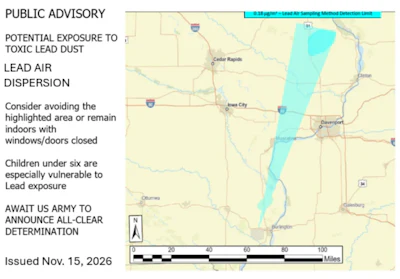
If you're driving through Iowa Friday, you could face one of the weirdest, and most hazardous conditions you're likely to encounter during your driving career, and its one with significant health implications.
The U.S. Army plans to detonate 68 barrels of lead azide at its Iowa Ammunition Plant in Middletown at about noon Central Time. The explosion will release a cloud of lead dust into the air. That plume is expected to travel on a path from the plant in southeast Iowa northward between Iowa City and Davenport, over Interstate 80 and possibly into northwest Illinois.
The Army warns the public to avoid unnecessary travel through impacted area.
The Army said on-site detonation is the safest way to eliminate the material. The degraded lead azide has been deemed unsafe for relocation, by the Army.
The lead dust is expected to settle to the ground causing numerous problems.
The Army issued a warning, which said:
To minimize potential exposure, members of the public who live or work in the affected areas should consider taking the following actions on the day of the detonation:
- Consider avoiding the affected area
- If you are inside of the affected areas, avoid outdoor air by staying indoors
- Keep windows and doors closed
- If it is safe to do so, set heating and cooling systems to “recirculate” to minimize outdoor air exposure and maximize indoor air filtration until the plume passes by your community
- Avoid unnecessary travel through impacted areas
- After the U.S. Army determines the air exposure period has ended, consider cleaning indoor and outdoor surfaces such as play surfaces for children and windowsills
- If your car was parked outside, consider washing your car at a car wash to minimize your contact with potentially exposed surfaces
It also suggested resident and others can learn more about actions they can take to protect themselves and and their families from potential exposures to lead at https://www.epa.gov/lead/actions-reduce-potential-leadexposure and https://www.epa.gov/lead/learn-about-lead
The Army said it will release two maps; one for airborne exposure to lead dust through respiration, and one for exposure from lead dust on surfaces.
The maps will be updated at this website: https://www.army.mil/asc#org-iowa-army-ammunition-plant.
The Army suggests members of the public should check for updates to these maps siz hours in advance of the detonation and every hour thereafter until the detonation.
After the event, the US Army will issue a final estimate of the impacted area.
According to the Army, lead azide was used in primers to ignite propellant charges or start chain reactions in small-caliber ammunition, mortar rounds, and rockets.